How to Jump Start a Car Safely: A Step-by-Step Guide

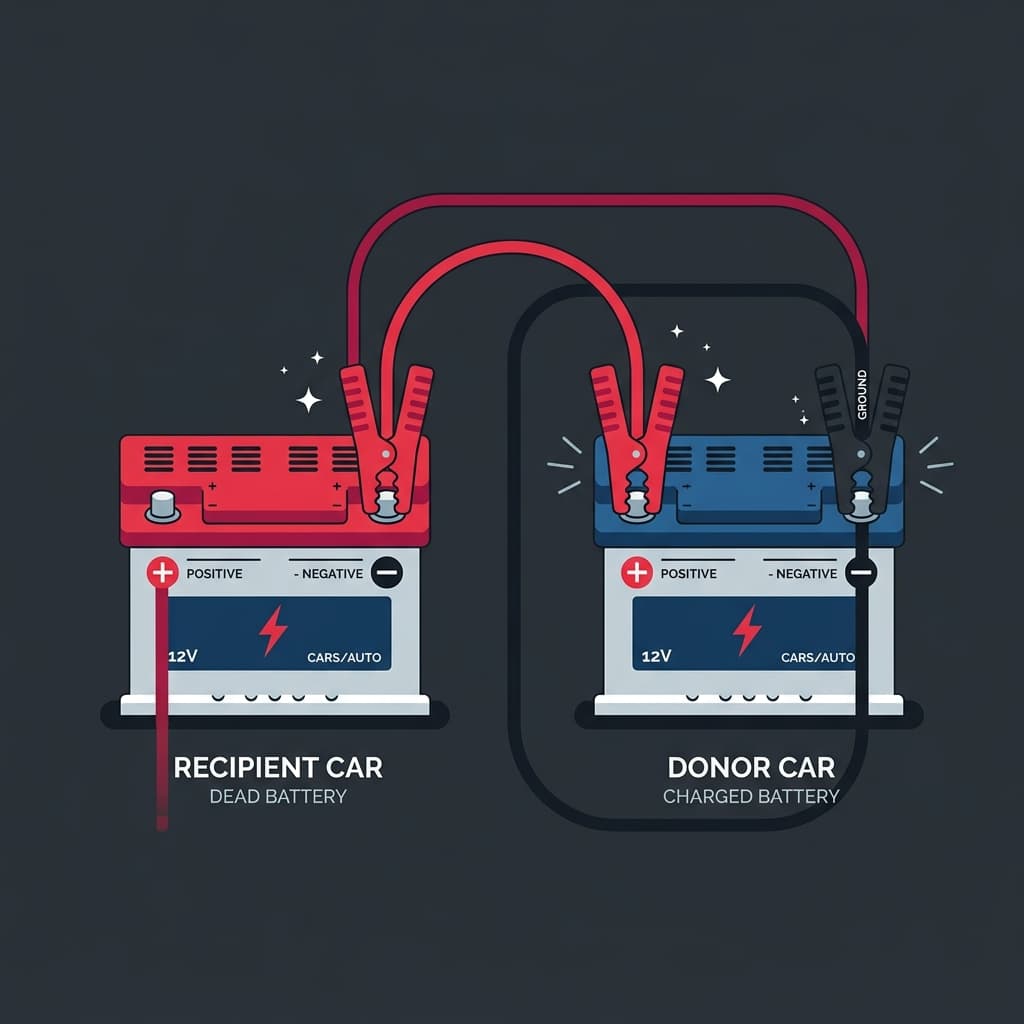
Table of Contents
Finding yourself stranded with a dead battery is incredibly frustrating. While learning how to jump start a car is a fundamental skill every driver should possess, modern vehicles are packed with sensitive electronics that can easily be destroyed by a simple mistake.
Before you pull out the jumper cables, you must understand how to jump start a dead battery safely.
[!WARNING] Always consult your owner's manual first. Many modern vehicles (especially hybrids, EVs, and luxury cars) have specific jump-starting procedures or remote battery terminals located away from the actual battery. Incorrectly jumping some modern vehicles can cause thousands of dollars in electrical damage.
When Is Jump-Starting Appropriate?
A jump start is only designed to fix one specific problem: a battery that does not have enough voltage to turn the starter motor.
You likely have a dead battery if:
- You turn the key (or push the start button) and hear a rapid "clicking" sound.
- The dashboard lights are extremely dim or completely dark.
- You accidentally left the headlights or an interior light on overnight.
Do NOT attempt a jump start if:
- The battery case looks swollen, cracked, or is leaking fluid.
- The battery is frozen (a risk in extreme sub-zero winter temperatures).
- You smell sulfur or rotten eggs near the battery.
Required Equipment
- A high-quality set of jumper cables (thicker cables with lower gauge numbers, like 4-gauge, are better than thin, cheap cables).
- Safety glasses and work gloves (batteries contain corrosive acid and can vent explosive hydrogen gas).
- A "donor" vehicle with a good battery of the same voltage (almost all standard passenger cars are 12-volt).
Step-by-Step Jumper Cable Procedure
If you have confirmed it is safe to proceed and your owner's manual does not specify a different procedure, follow these steps exactly in this order.
Step 1: Position the Vehicles
Park the donor car facing the car with the dead battery so the jumper cables can easily reach between them. The vehicles must not touch each other. Put both cars in Park (or Neutral for a manual transmission), engage the parking brakes, and turn both ignitions OFF.
Step 2: Locate the Terminals
Identify the Positive (+) and Negative (-) terminals on both batteries. The positive terminal usually has a red cover and a plus sign. The negative terminal is usually black with a minus sign.
If your battery is buried in the trunk or under the seat, your car likely has designated metal "jump posts" under the hood. Check your manual.
Step 3: Connect the Cables (The Order Matters!)
Connecting the cables in the wrong sequence can cause a dangerous spark near the battery. Follow this exact order:
- Red to Dead: Clamp one end of the RED (Positive) cable to the Positive (+) terminal of the DEAD battery.
- Red to Donor: Clamp the other end of the RED (Positive) cable to the Positive (+) terminal of the DONOR battery.
- Black to Donor: Clamp one end of the BLACK (Negative) cable to the Negative (-) terminal of the DONOR battery.
- Black to Metal (Ground): Do not connect the final clamp to the dead battery! Instead, clamp the final BLACK (Negative) cable to an unpainted, exposed metal surface on the engine block or frame of the car with the dead battery, away from the battery itself (a heavy metal bolt is usually perfect). This provides a safe ground and keeps any potential sparks away from the battery.
Step 4: Start the Donor Car
Start the engine of the donor vehicle and let it run for a few minutes. This allows the good alternator to push some charge into the dead battery.
Step 5: Start the Dead Car
Attempt to start the car with the dead battery. If it doesn't turn over immediately, wait another 3-5 minutes and try again.
Step 6: Remove the Cables Safely
Once the dead car is running, leave it running. You must remove the cables in the exact reverse order that you connected them. Do not let the red and black clamps touch each other!
- Remove the BLACK cable from the grounded metal surface on the previously dead car.
- Remove the BLACK cable from the donor car's negative terminal.
- Remove the RED cable from the donor car's positive terminal.
- Remove the RED cable from the previously dead car's positive terminal.
What to Do If the Car Does Not Start
If you followed the steps correctly and the car still rapidly clicks or does absolutely nothing, your battery may be completely destroyed and unable to hold a charge, or you may have a bad starter motor or alternator.
At this point, it is safest to stop trying and call a professional towing or roadside assistance service.
Modern Vehicles, EVs, and Hybrids
- Hybrids and EVs: Never attempt to use an electric vehicle or a hybrid to jump-start a traditional gas car. The 12-volt system on an EV is not designed to handle the massive amperage draw of a gas engine starter motor, and doing so can destroy the EV's electrical architecture.
- Jump Packs: Many modern drivers prefer to carry a lithium-ion "jump pack" in their trunk. These are much safer than traditional cables because they eliminate the need for a donor car and feature built-in reverse-polarity protection (they simply won't work if you hook them up backward).